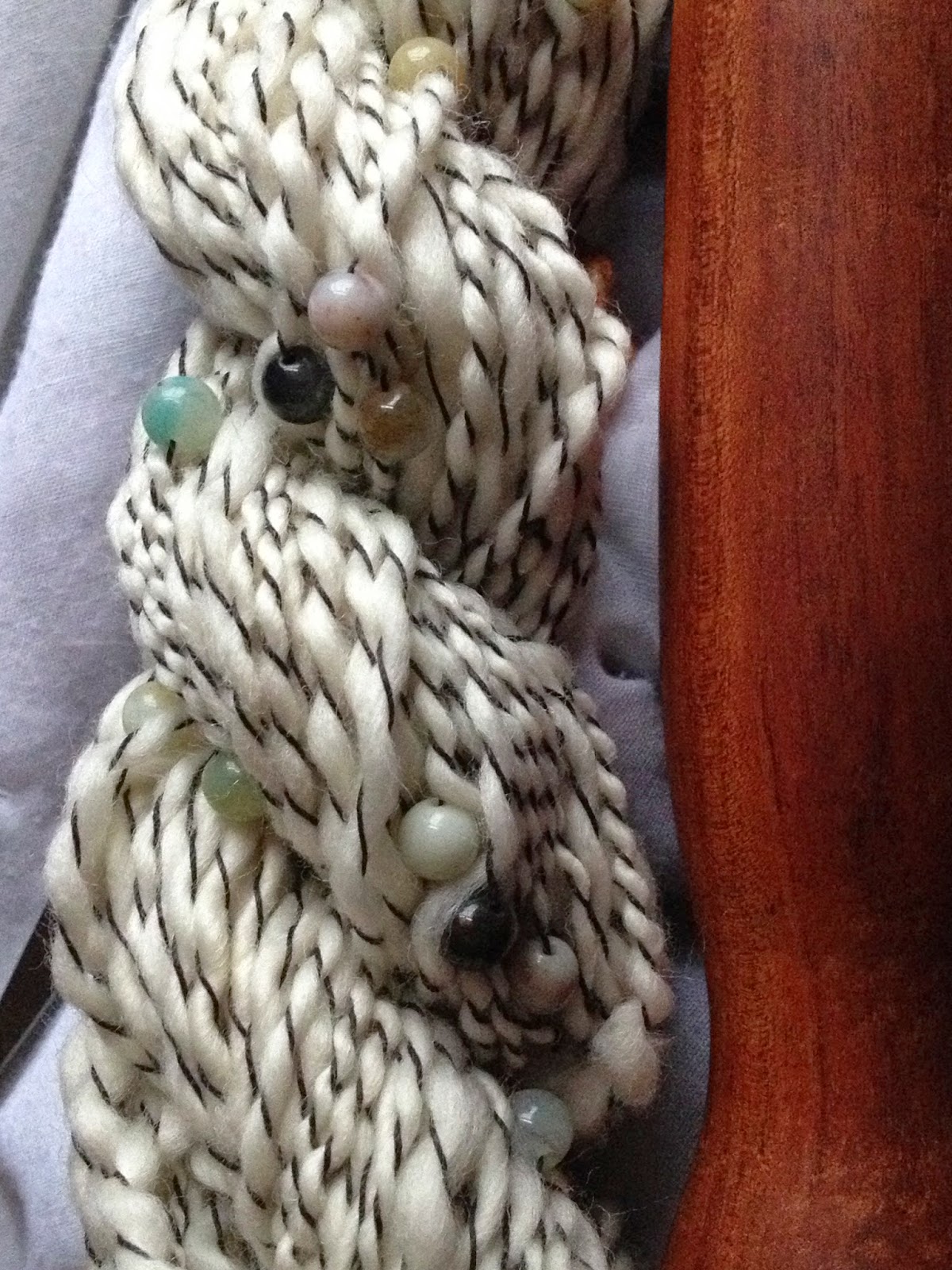
Ok, so I fell behind a little... This is my February installment of the 2014 Fiber Challenge: Polwarth. I have to say, contrary to expectations from things I'd heard about it, I didn't really enjoy working with this wool. It was slippery, and waaay too eager to fall apart. I was informed by a knowledgeable friend after viewing a Facebook photo of the unspun fiber going into the orifice that it looked as if it may have been over-processed, but that might be my fault for overdrafting it. Anyway, plying it was much, much better; I tried two different things and really like the way they both turned out. First, I had two bobbins so I plied them together; then when I ran out of one, I used black thread and beads. This one is my favorite - I am so enamored of how it turned out... as you can probably tell from the amount of pictures. My next challenge shall be Navajo Churro. I make no punctual guarantees.
Showing posts with label spinning. Show all posts
21 April 2014
The Late, Late, Late, LATE Show
Ok, so I fell behind a little... This is my February installment of the 2014 Fiber Challenge: Polwarth. I have to say, contrary to expectations from things I'd heard about it, I didn't really enjoy working with this wool. It was slippery, and waaay too eager to fall apart. I was informed by a knowledgeable friend after viewing a Facebook photo of the unspun fiber going into the orifice that it looked as if it may have been over-processed, but that might be my fault for overdrafting it. Anyway, plying it was much, much better; I tried two different things and really like the way they both turned out. First, I had two bobbins so I plied them together; then when I ran out of one, I used black thread and beads. This one is my favorite - I am so enamored of how it turned out... as you can probably tell from the amount of pictures. My next challenge shall be Navajo Churro. I make no punctual guarantees.
30 January 2014
Well, DERP
So, I find a correction is in order for my previous post. This doesn't bode well. So, I got gifted three bags of fiber from a friend, and in the bustle of our weekly meeting, I forgot to nail down the information on the two animal fibers (the third was a bag of cotton). On the bag of the fiber I chose to spin first was written, "Gray Suffolk," which I find now is NOT referring to breed of provenance, but rather to an arbitrary color grading system. The gray fiber I have is Gray Suffolk, but the fiber is Herdwick. Herdwick sheep are very tough and durable, and as I noticed while spinning the 8 oz. I was given, this quality extends to their wool. The Wikipedia entry for this breed is quite an interesting cross-section of their history and the history of the British Lake District.
Next month's entry in the 2014 Fiber Challenge will be Polworth, purchased from a farm right here in North Carolina, Three Waters Farm, and the month after that I suspect will be the other bag of animal fiber that I was gifted which I have asked, confirmed, and double checked as Navajo Churro. Let's hope this goes better in the future...
25 January 2014
2014 Fiber Challenge: January/Suffolk (HERDWICK)
One of my craft related resolutions at the beginning of this month was to experiment with a wider variety of fibers and to keep notes on what I thought of them. At the moment I have four small quantities of fibers I haven't ever spun or even handled in their raw state before. This includes cotton, which I've been playing around with a little since I got it. Not promising. Lots of swearing. But more on that later.

My first entry will be Suffolk. Now, Suffolk is primarily a meat breed, and so the fiber is very coarse. Generally, I'm told, it's used for outdoor blankets or rugs, and I can see why. It's scratchy and sturdy, and reminds me a little of butcher's twine. It's also pretty easy to spin up; properly pre-drafted, it doesn't break off (at least in the section I spun last night, which is about a third of the amount I have.
Now, as I said, normally Suffolk is not used for fine garments such as shawls, but I have a special all handspun shawl that I'm working on, and I'll be using at least a portion of the Suffolk in it, even if it's just a stripe. Here are some pictures of the wool, both spun and unspun.
Maybe I'll try to do one new fiber per month or something along those lines; I suspect it will take me the whole month to complete the cotton, if I can do it while holding on to my sanity...

My first entry will be Suffolk. Now, Suffolk is primarily a meat breed, and so the fiber is very coarse. Generally, I'm told, it's used for outdoor blankets or rugs, and I can see why. It's scratchy and sturdy, and reminds me a little of butcher's twine. It's also pretty easy to spin up; properly pre-drafted, it doesn't break off (at least in the section I spun last night, which is about a third of the amount I have.
Now, as I said, normally Suffolk is not used for fine garments such as shawls, but I have a special all handspun shawl that I'm working on, and I'll be using at least a portion of the Suffolk in it, even if it's just a stripe. Here are some pictures of the wool, both spun and unspun.Maybe I'll try to do one new fiber per month or something along those lines; I suspect it will take me the whole month to complete the cotton, if I can do it while holding on to my sanity...
Subscribe to:
Posts (Atom)

